What is the underlying operational framework of TOEFL iBT Home Proxy Testing?
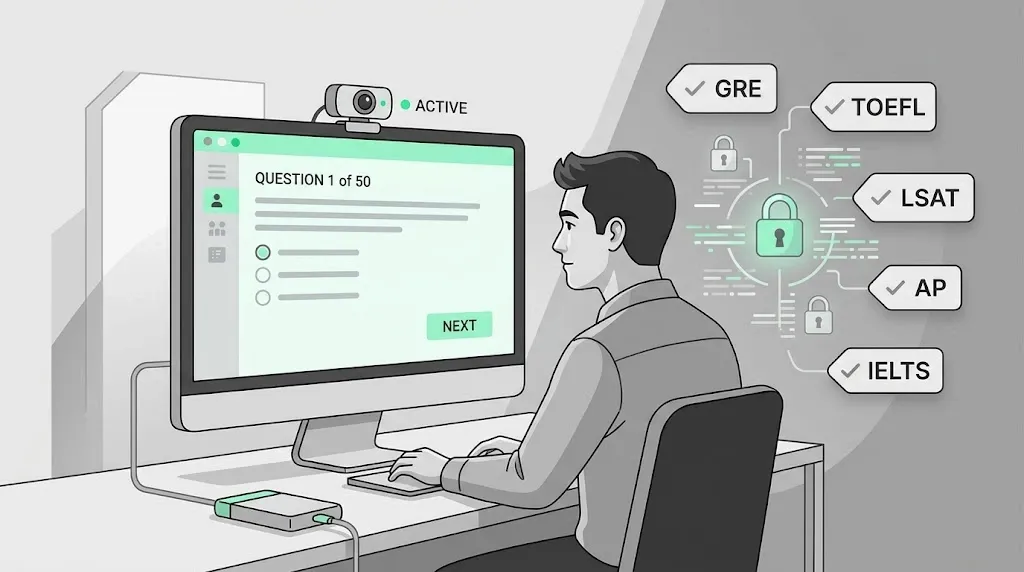
TOEFL iBT Home Proxy Testing (also referred to as TOEFL Home Edition Assistance) is an elite background-enhancement service designed to help candidates overcome language bottlenecks and secure their target scores within a condensed timeframe. By leveraging proprietary software integration or discrete hardware modifications, an external expert team provides real-time answer delivery or direct testing support. These methods operate completely undetected beneath the security frameworks of the ETS Secure Browser, ProctorU monitoring systems, and live online invigilators.
Currently, the most reliable operational framework in the industry combines advanced remote driver architecture with strategic gaze-flow management. Under this system, elite subject-matter experts independently generate high-scoring, non-templated, and completely original answers for the Listening, Reading, and Writing sections in real time, streaming them directly to the candidate.
Can the Speaking section of the TOEFL be entirely delegated to a proxy?
No. Because the TOEFL features a highly personalized, subjective Speaking section where the system records your actual voice for AI-driven voiceprint verification and human evaluation, no reliable agency can or should offer a full substitute for the Speaking portion.
In practical operation, our elite team provides precise, real-time response outlines, high-scoring vocabulary, and simulation scripts directly to you during the live test, which you will read and deliver naturally. With this method, the objective input/output sections (Reading, Listening, and Writing) are precisely engineered to achieve near-perfect scores of 80–85+. Combined with your personal vocal delivery, your cumulative score will comfortably land within the 95–110 high-tier range (equivalent to 4.5–6.0 under the latest CEFR alignments).
Please note that candidates must possess a baseline level of English reading and adaptive fluency. If severe stuttering or speech fragmentation results in an extreme statistical discrepancy between the Speaking section and the other near-perfect sections, it may trigger an automated data audit by ETS. We conduct comprehensive pre-exam simulation drills with every client to eliminate this risk.
What are the core technical advantages of DrEXAM’s TOEFL proxy service?
Our primary competitive edge lies in our proprietary, kernel-level technical infrastructure and its absolute security standard. The vast majority of agencies on the market lack proprietary technology; they still rely on commercially available remote-control software (such as TeamViewer, AnyDesk, or ToDesk) or cumbersome hardware screen-splitters. Under the rigorous process scans, low-level hook detections, and dual-camera monitoring arrays deployed by ETS, these rudimentary methods will immediately trigger system shutdowns, resulting in immediate lifetime bans.
DrEXAM maintains independent software development capabilities. We deploy an exclusive, undetectable remote driver solution (Zero-Intervention Remote Architecture). Running at the deepest level of the operating system, our driver completely bypasses the security browser’s detection vectors, establishing a zero-latency, zero-signature external feed to display answers. Furthermore, because our technology is entirely private and deployed via unique, individualized codebases for each client, it completely eliminates the risk of mass "score holds" caused by shared code signatures, ensuring your exam remains fully protected behind an elite security barrier.
How do you guarantee exam security and safety?
- Payment & Financial Security (Zero-Risk Model): Backed by absolute confidence in our score-delivery capabilities, we offer an authentic pay-after-score model alongside flexible post-deposit payment structures. Candidates pay the remaining balance only after verifying their official score report directly on the ETS website, completely eliminating industry risks such as sudden price hikes, disappearing agencies, or post-exam extortion.
- Privacy & Data Security (Zero-Retention Policy): Throughout the pre-sale consultation and live exam execution phases, we never proactively collect, request, or retain sensitive primary data, such as passport scans, national IDs, or ETS account credentials. Upon successful completion of the exam, our team completely formats and purges all communication logs, remote deployment data, and client traces. High-score case showcases are strictly optional and heavily redacted to protect client identity.
- Post-Exam & Continuity Security (Zero Sunk Costs): While our elite experts boast exceptional precision, standardized testing always carries dynamic policy risks. We provide a binding post-exam commitment: if an act of God or a technical anomaly prevents you from hitting your target score, or if your score is withheld (HOLD) or canceled, our agency will unconditionally reimburse your previous exam registration fee and provide complete, complimentary re-testing assistance without evasion.
What are the latest TOEFL proxy and score-guarantee methodologies?
As ETS surveillance technology evolves, the safety profiles of current market solutions vary drastically. They are categorized into four major approaches:
- Advanced Remote Driver Solutions (Technical Framework — Highly Recommended): The most secure, non-contact assistance method currently available. It utilizes proprietary, kernel-level system drivers to transmit screen data externally without modifying or disrupting the active processes of the ETS Secure Browser or ProctorU. External experts review the live stream to complete the exam 1-on-1 in real time, while the candidate simply manages their gaze and matches the pacing on the front end. Because each deployment utilizes a unique, individualized codebase, this method successfully circumvents AI eye-tracking and big-data anomaly detection.
- High-Definition Camera & Gaze-Flow Management (Physical Framework): A hardware-only method that does not intervene in the computer's operating system. Miniature high-resolution cameras are hidden in monitor blind spots to relay the exam screen to the support team. Because it introduces no software footprint, it is immune to low-level process scans. However, this method requires immense composure; under dual-camera surveillance, candidates must meticulously manage their eye focus and mouse trajectories, as any unnatural gaze deviation can result in an immediate manual flag.
- Full Substitute & Pre-Exam Leaks (High-Risk / Obsolete): Full substitution involves a proxy examinee entering an offline test center using forged or composite identification, or replacing the candidate entirely at home. Due to the widespread implementation of AI facial recognition, voiceprint analysis, and cross-referenced biometric history tracking by ETS, this method carries an exceptionally high risk of detection and legal exposure. Pre-exam leaks rely on securing test questions early; however, ETS has heavily mitigated this by introducing randomized real-time item updates and multiple variable test forms, rendering memorization highly unreliable.
- Hardware Screen-Splitters & Commercial Remote Tools (Technically Phased Out): This includes using publicly available software like AnyDesk, TeamViewer, or ToDesk, or utilizing heavy hardware splitters. These approaches are completely blacklisted by the ETS Secure Browser's low-level hook detection. Activating them will cause an immediate system lockout and an automatic ban.
Do you provide free exam registration assistance?
Yes. For domestic or international candidates who are unfamiliar with the registration protocols on the official ETS website, we provide complimentary, expert exam booking services.
Please note that if your registration address is set to Mainland China, payment must be processed by purchasing an examination voucher through the Hong Kong Examinations and Assessment Authority (HKEAA). If an overseas address is used, you can settle payment directly online. Additionally, if you plan to schedule a test date within 7 days of registration, ETS will assess a mandatory $40 Late Fee.
Is TOEFL proxy testing still safe under the Dual-Camera Proctoring Model?
Yes, but it demands an exceptionally high technical standard from the provider. Since the implementation of the dual-camera framework, the primary webcam monitors facial expressions and live eye tracking, while a secondary mobile device is positioned diagonally behind the candidate to record the monitor, keyboard, mouse, and hand movements.
Under this rigorous layer of surveillance, traditional commercial control tools and bulky hardware splitters are flagged instantly. The only viable and highly secure solution is our proprietary, undetectable remote driver technology (Zero-Intervention Remote). It streams screen information externally without disrupting official exam processes, allowing our expert team to deliver 1-on-1 real-time test completion smoothly.
What causes a TOEFL score to be delayed (HOLD), canceled, or missing after the test?
When a TOEFL Home Edition exam concludes smoothly but fails to generate a score, the core cause is rarely a hardware or network glitch. Instead, it indicates that the session has triggered the Post-Exam Big Data Review Mechanism due to the following anomalies:
- Abnormal Pacing & Rhythm: The system detects that a candidate passed through highly complex academic Reading or Listening passages with an unnaturally rapid response time (e.g., instant correct selections).
- Extreme Cross-Section Discrepancies: The candidate scores perfect or near-perfect marks in Reading, Listening, and Writing through external assistance, but exhibits heavy hesitation or minimal fluency in the Speaking section, triggering a statistical performance mismatch.
- AI Behavioral Flags: The candidate displays suspicious hand movements or repeatedly shifts their gaze away from the primary display area during the exam window.
- Essay Plagiarism or Artificial Fingerprints: The Writing section utilizes a high-risk, generic template, or a technically deficient agency used public code structures, prompting a collective cancellation during automated plagiarism screening.
What happens if my score is placed on HOLD, canceled, or falls short of the target?
If your TOEFL score is placed on HOLD, canceled post-release, or fails to reach the contractually agreed-upon score, our agency will provide completely free re-testing assistance. Please note that all language proficiency exams carry an inherent statistical variance regarding score releases; you should never trust any agency making a fraudulent "100% guaranteed release" claim. We mitigate this reality through comprehensive financial and operational guarantees.
How long does it take to check the official TOEFL score report?
Provided the exam session does not trigger any severe behavioral flags or administrative reviews, the standard release cycle for the TOEFL iBT Home Edition is 6 to 8 days post-exam. Candidates can access their official score reports directly via their MyTOEFL profile on the official ETS website.
Given that international universities dynamically adjust their admission policies regarding the "Home Edition" indicator on official transcripts, we strongly advise candidates to secure their target scores six months prior to university application deadlines to allow for an adequate policy buffer.
Will my score report or case details be made public after the exam?
This is entirely up to you. Given today’s strict global academic compliance environments, professional assistance agencies must strictly uphold absolute non-disclosure protocols.
Throughout our entire operational pipeline, we never mandate or store sensitive primary assets like original passport scans. Once your service concludes successfully, our team permanently deletes and formats all remote configurations, chat histories, and client data. As a principle, we advise against showcasing high-score results; if a case study is required for promotional verification, all identifiers including names, test IDs, and dates are subjected to deep mosaic blurring and heavy redaction.